Care Home Costs vs Staying at Home: The Real 2026 Numbers
Care home costs vs staying at home, with verified 2026 UK and US figures: what each option really buys, and the cheaper middle path most families miss.
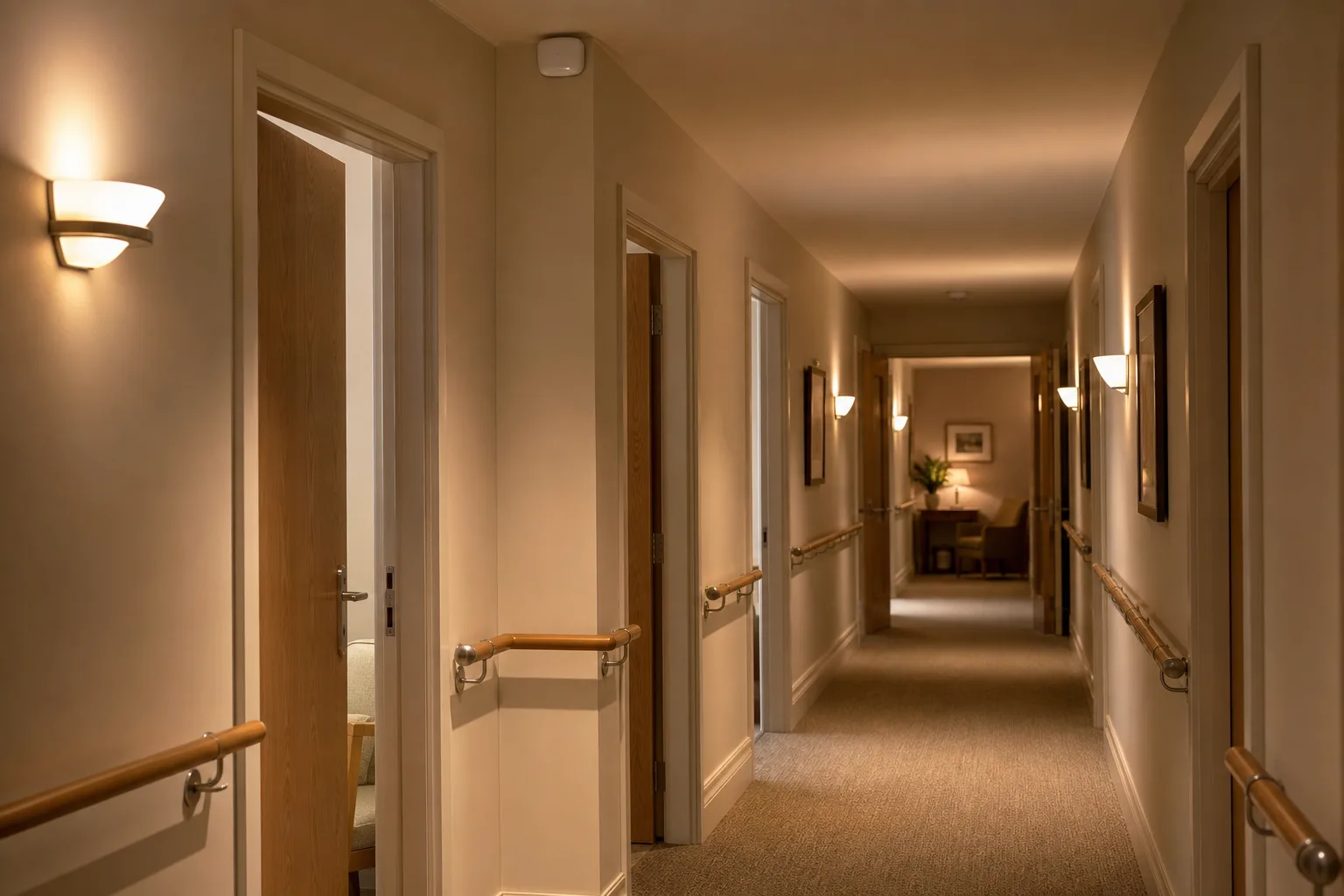
Sunday afternoon, your parent's kitchen table. The care home brochure has been open at the fees page for ten minutes, because somebody has to say the number out loud: £1,300 a week. Your parent looks past you, out at the garden they have kept for thirty years, and says nothing at all.
This is an article about that number. It weighs care home costs vs staying at home, every figure from a named source with a link, UK and US. First the real invoices, for care homes and for care at home. Then the more useful question: what each invoice actually buys, which line items you can replace for less, and which ones you honestly cannot.
What a care home actually costs in 2026
Start with the UK. Lottie's 2026 figures put the average self-funded residential care home at £1,300 a week and a nursing home at £1,512 a week. Over a year, that is around £67,600 for residential care and £78,600 for nursing care. London runs higher, and dementia care adds more again. The fee is not fixed, either: most homes review prices annually, and the reviews go one way.
The US reference is the Genworth/CareScout Cost of Care Survey. Its 2024 medians: assisted living at $70,800 a year, a semi-private nursing home room at $111,325, a private room at $127,750. Each of those rose 7 to 10 percent in a single year, so treat them as a floor, not a ceiling.
Care at home is priced by the hour. In the UK, Lottie's 2026 average for domiciliary care is £32 an hour. In the US, Genworth's 2024 median for a home health aide is $77,792 a year on a 44-hour week, which works out to $34 an hour.
These are national averages. Your town will be above or below them. But they are honest anchors, and they are enough to do the arithmetic that follows.
Care home costs vs staying at home, side by side
Here is the table most brochures do not print. Annual totals, mixing the sourced medians above with rows worked out from the hourly rates.
| Option | UK, per year | US, per year |
|---|---|---|
| Nursing home (24-hour nursing) | ~£78,600 | $111,325 (semi-private room) |
| Residential care home / assisted living | ~£67,600 | $70,800 |
| Full-time home care (44 hours a week) | ~£73,200 | $77,792 |
| Part-time home care (2 hours a day) | ~£23,300 | ~$24,800 |
| Family care + 4 paid hours a week + sensor monitoring | ~£6,700 plus monitoring | ~$7,900 (year one, kit included) |
Workings: the top three rows are the medians cited above. The part-time and family rows multiply the average hourly rates (£32 UK, $34 US). The monitoring figure uses OdeCare's US pricing: kits from $590 to $790 including professional installation and the first three months of service, then $29 a month.
Two things in this table decide most family decisions. First, full-time home care costs roughly the same as a care home place. A care home is not overpriced hourly labour; it is bulk-bought labour, plus a building. Second, the price cliff sits between "someone there all day" and "someone there for specific hours". So the real financial question is not "care home or not". It is: does your parent need continuous hands-on care, or help with certain tasks at certain times?
What you actually buy at each tier
A care home invoice is a bundle: a room, meals, laundry, cleaning, personal care, activities, and supervision. Unbundle it and most items have plain, cheaper substitutes. Your parent already owns a room. Meal deliveries exist. A cleaner is an hourly hire. Help with washing and dressing is exactly what hourly home care is for.
What keeps families signing the big invoice is the last item on the list. Supervision, and specifically supervision at night. In a care home, someone is on duty between the last evening round and breakfast. At home, from the moment you say goodnight on the phone until you call the next day, nobody would know if something went wrong.
That fear is rational, and it has numbers behind it. The CDC reports that one in four adults over 65 falls each year. What decides the outcome is usually not the fall itself but the time spent on the floor afterwards: in a New England Journal of Medicine study of older people found helpless at home, mortality was 12% among those helpless for less than an hour and 67% among those helpless for more than 72 hours, and 62% of the survivors could not return to independent living.
A daily check-in service covers mornings for a few pounds or dollars a day. Emergency pendants are the traditional answer for the hours in between, but they depend on a person pressing a button at the worst moment of their life: in one study of real falls, 97% of worn emergency buttons went unpressed. Home sensor monitoring takes the button out of the equation: radar and presence sensors learn the household's normal rhythm and alert the family when it breaks — no movement by mid-morning, an unusually long bathroom stay, activity stopping at night. Nothing to wear, nothing to charge, no camera, no microphone. From $29 a month once the kit is installed.
Be clear about what that buys. No sensor lifts someone off the floor, and monitoring is not an emergency service. What it changes is the number that the NEJM study says matters most: how long it takes before somebody knows.
What money does not solve
Now the accountant has to be honest in the other direction. Some situations do not respond to arithmetic, and pretending otherwise costs families dearly.
Dementia with wandering needs a person, around the clock. A sensor can tell you the front door opened at 2 a.m.; it cannot stand in the doorway. Complex nursing needs — two-person transfers, pressure-area care, conditions that need clinical eyes every day — are what a nursing home's £78,600 actually buys, and it buys something real. And when a family member is already providing forty unpaid hours a week and starting to break, the "cheap" option is not cheap; it is being paid for in someone's health.
If you are unsure which situation yours is, we keep a plain checklist of signs your parent needs more help — the point where extra hours and technology stop being enough is a judgment call, and it deserves better than guesswork.
The middle path most families miss
Most families price exactly two options: everything (£67,600 a year) or nothing (carry on and hope). The middle rarely gets a quote, and the middle is where most older adults actually live well.
It looks like this. Your parent stays in their own home. Family does what family already does: Sunday lunch, phone calls, the big shop. Paid carers take the tasks that need training or a professional's distance — say, three mornings a week for washing and dressing. A cleaner takes Thursdays. And sensors cover the hours nobody can sit through: the nights, the empty weekday mornings, the gaps between visits.
Price that week with the averages above and you land near £6,700 a year in paid hours, plus monitoring — against £67,600 for the residential home it replaces. One care home year funds roughly eight or nine years of the middle path. That runway matters, because needs change: the middle path is not a forever plan, it is a way of not spending the house in the years before hands-on care is genuinely needed. If that day comes, the money is still there.
We have written a full comparison of alternatives to a care home — sheltered housing, live-in care, moving in with family — with the honest trade-offs of each. Read it before anyone signs anything. The brochure on the kitchen table is one option, not the only one, and it is worth knowing exactly what its number buys before your parent has to look away at the garden again.