A guide for families
Fall detection devices: what actually works when it matters
One in four adults over 65 falls each year, and the damage is usually decided by how long they wait for help — not by the fall itself. Here's an honest look at the four ways technology can notice a fall, including where each one quietly fails.
The four mechanisms
Every fall detection device works one of four ways
Hundreds of products, four physics. Which mechanism a device uses determines what it catches, what it misses, and what it demands from your parent.
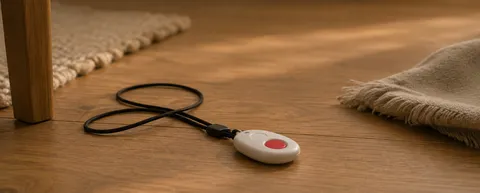
Pendants & bracelets
An accelerometer feels the impact and posture change of a fall, then calls a monitoring centre or family.
- Simple, works out of the box
- Mobile versions work outside the home
- Only works while worn — and many seniors quietly stop wearing them
- Soft falls (sliding off a chair) are often missed
- In real falls, buttons frequently go unpressed — confusion, unconsciousness, or "not wanting to bother anyone"
Watches (Apple, Samsung, medical)
Accelerometer + gyroscope detect hard falls; the watch can call emergency services automatically.
- Great if your parent already loves the watch
- Works everywhere, incl. outdoors
- Needs charging every day — most misses happen when it's on the charger at night
- Tuned for hard falls; slow crumples often don't trigger
- Small screens and menus frustrate many older users
Camera-based detection
AI watches video feeds and flags a person on the floor.
- Can be accurate in covered rooms
- Family can visually confirm what happened
- No cameras in bathrooms — where a huge share of falls happen
- Being filmed at home is a dealbreaker for most parents
- Privacy, storage and consent questions never really go away
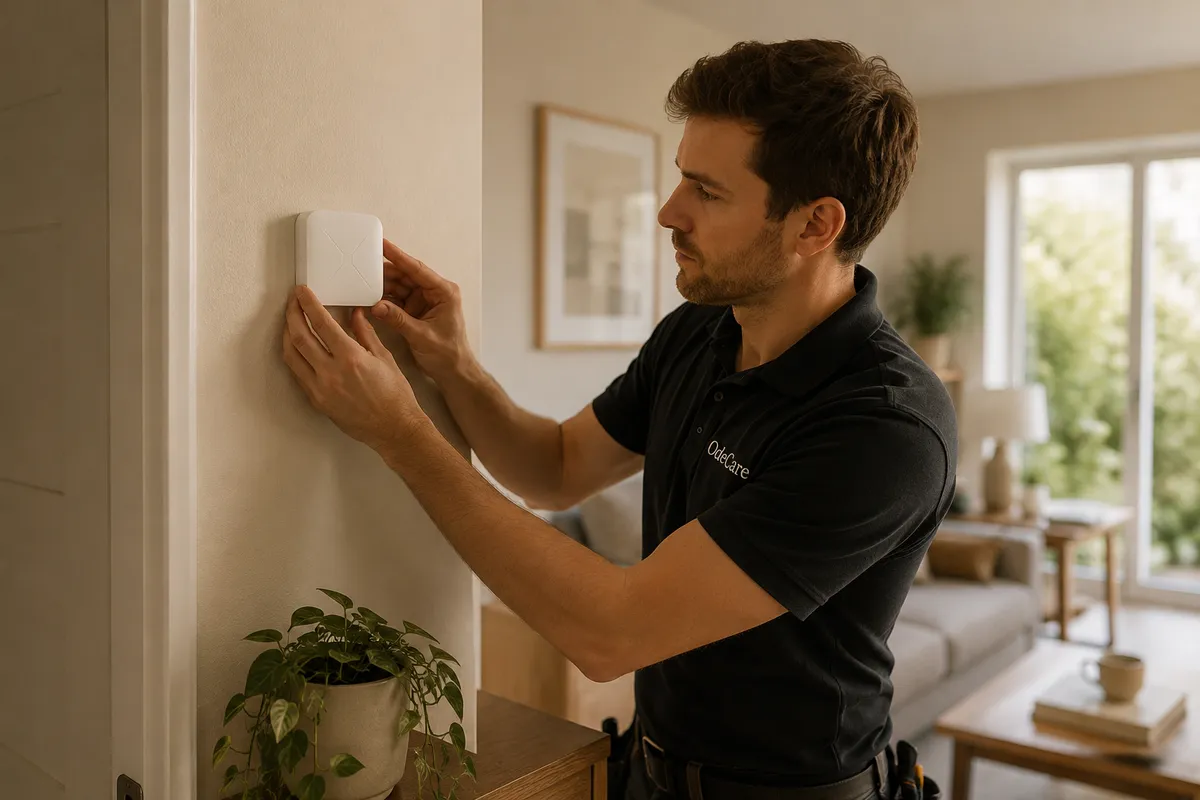
Radar sensors (what OdeCare uses)
Millimetre-wave radar on the wall senses position and motion — including a person on the floor — with no image ever created.
- Nothing to wear, charge, press or remember
- Works in bathrooms and at night — no camera, no light needed
- Cross-checks with motion/door sensors to cut false alarms
- Home-only — doesn't follow them to the store
- Higher upfront cost than a pendant
Side by side
Fall detection compared: coverage, honesty included
| Pendant / bracelet | Smartwatch | Camera AI | Radar sensors | |
|---|---|---|---|---|
| Catches falls… | While worn | While worn & charged | In rooms with cameras | Anywhere at home |
| Bathroom coverage | If worn in shower | If waterproof & worn | No — cameras don't belong there | Yes |
| Night coverage | Usually on nightstand | Usually charging | Poor in the dark | Yes — radar needs no light |
| Depends on the person | Fully | Fully | No | No |
| Privacy | Good | Good | Video in the home | No image ever exists |
| Typical year-one cost | $300–800 | $370–1,100 | $50–540 | $851–1,051 (OdeCare) |
US ranges, July 2026. OdeCare figure = kit installed ($590–790, includes 3 months) + $29/mo after.
The fee question
Fall detection without a monthly fee: the honest answer
It's one of the most-searched wishes — and mostly a trap. Detection without alerting is useless, and alerting means infrastructure someone maintains: a monitoring centre, a cellular connection, or an app service. That's what the fee pays for.
- Truly no fee: a smartwatch calling 911 directly. Real, but only while worn and charged — and emergency services get called for false alarms too.
- Low fee, family-first: systems that alert your family instead of a call centre. OdeCare works this way — $29/mo after the included 3 months, alerts go to the people who'll actually respond.
- Classic fee: $25–60/mo monitoring-centre services. You pay for a professional dispatcher — worth it if family can't be reachable.
Rule of thumb: don't optimise the fee to zero — optimise minutes-to-help. An unworn zero-fee device is the most expensive option there is.
Why speed beats detection
The hour on the floor is the real enemy
In a New England Journal of Medicine study of older adults living alone, most who fell could not get up without help. Those helped within the first hour mostly recovered; among those who lay for an hour or more, serious decline and hospitalization became far more likely. Detection technology matters exactly as much as it shortens that interval — no more.
That's also why "my parent has a phone" isn't a plan: the phone is on the counter, the fall is in the bathroom, and the median wait becomes hours. Read what to do when a parent falls at home — including the follow-up week that most families skip.
Under the hood
How radar fall detection actually works
Millimetre-wave radar — the same family of technology used in modern cars — reads reflections of low-power radio waves to know where a person is and how they're moving. A fall has a physical signature: rapid height change ending at floor level, followed by stillness. The sensor sees that signature without ever forming an image, which is why it can work in bathrooms and darkness where cameras can't and shouldn't.
One honest engineering note: a single reading is never trusted alone. Good systems confirm with context — is the person still at floor level? Is there prolonged inactivity where activity is normal? Did the bathroom visit pass its usual length several times over? This cross-checking is what separates a useful alert from a system your family learns to ignore.
The alert-fatigue trap
False alarms: the failure mode nobody prices in
Every fall detection device for elderly users fails in one of two directions: missing real falls, or crying wolf. The second is sneakier. A pendant that triggers when grandma sits down hard gets taken off "just for now". A watch that calls 911 from a dropped wrist gets fall detection disabled by a well-meaning grandson. A system that pings the family nightly gets muted.
When comparing senior fall monitoring options, ask each vendor one question: "what happens to a suspected fall before my phone rings?" If the answer is "we alert instantly on every trigger", expect noise. If the answer describes confirmation logic — floor-level presence, inactivity windows, multi-sensor agreement — you're buying something the family can live with for years.
Detection is half
Fall prevention: the part no device sells you
Detection shortens the wait for help; prevention shrinks the number of falls to detect. The unglamorous basics move the statistics more than any gadget: grab bars where balance is lost (bathroom, stairs), night lighting on the bed-to-bathroom route, securing loose rugs, a medication review with the GP — several common prescriptions affect balance — and strength work for legs, which CDC-backed programmes consistently show reduces fall risk.
Monitoring feeds prevention too: if the data shows three near-miss nights in the bathroom corridor this month, that's not an alert — that's a to-do list. Our guide on what to do after a parent fallscovers the follow-up week that most families skip.
The no-wearable option
OdeCare: fall awareness with nothing to wear
Radar and motion sensors learn your parent's home and rhythm. A fall-like event, a too-long bathroom stay, a night that breaks the pattern — your family knows in minutes, in plain words, with no camera and nothing your parent has to remember.
Questions families ask
Fall detection devices: FAQ
What is the best fall detection device for seniors?
It hinges on one question: will they reliably wear a device? If yes — a pendant or watch is simplest. If not (very common), ambient radar sensors detect falls in any room, including the bathroom, with nothing to wear, charge or press.
Are there fall detection devices without a monthly fee?
Mostly no — alerting needs infrastructure someone maintains. A smartwatch calling 911 is the real zero-fee case, but only works while worn and charged. Family-first systems like OdeCare keep it low: 3 months included, then $29/mo, with alerts going to your family directly.
Do fall detection bracelets work?
They work while worn — that's the catch. Real-world studies show worn buttons often go unused in actual falls, many people stop wearing bracelets within weeks, soft falls get missed, and hard sits trigger false alarms. Fine as a supplement; risky as the whole plan.
Can fall detection work without wearing anything?
Yes — wall-mounted radar detects fall-like events by position and motion, with no image created. It covers bathrooms and night-time, exactly where wearables usually aren't.
Does Medicare pay for fall detection?
Original Medicare generally doesn't. Some Medicare Advantage plans include an allowance as a supplemental benefit, and some state Medicaid waivers cover emergency-response services — check the specific plan.
How accurate is fall detection?
No system catches 100% — treat such claims as marketing. Wearables miss unworn moments and soft falls; cameras miss uncovered rooms; radar systems cross-check fall-like events with floor-level presence and inactivity to keep false alarms down. The metric that matters is minutes-to-help.
Keep reading