Fall Detection Without a Pendant: What Actually Works
Compare fall detection without a pendant through the moment that matters: what detects the fall, what sends an alert and what still depends on the person.
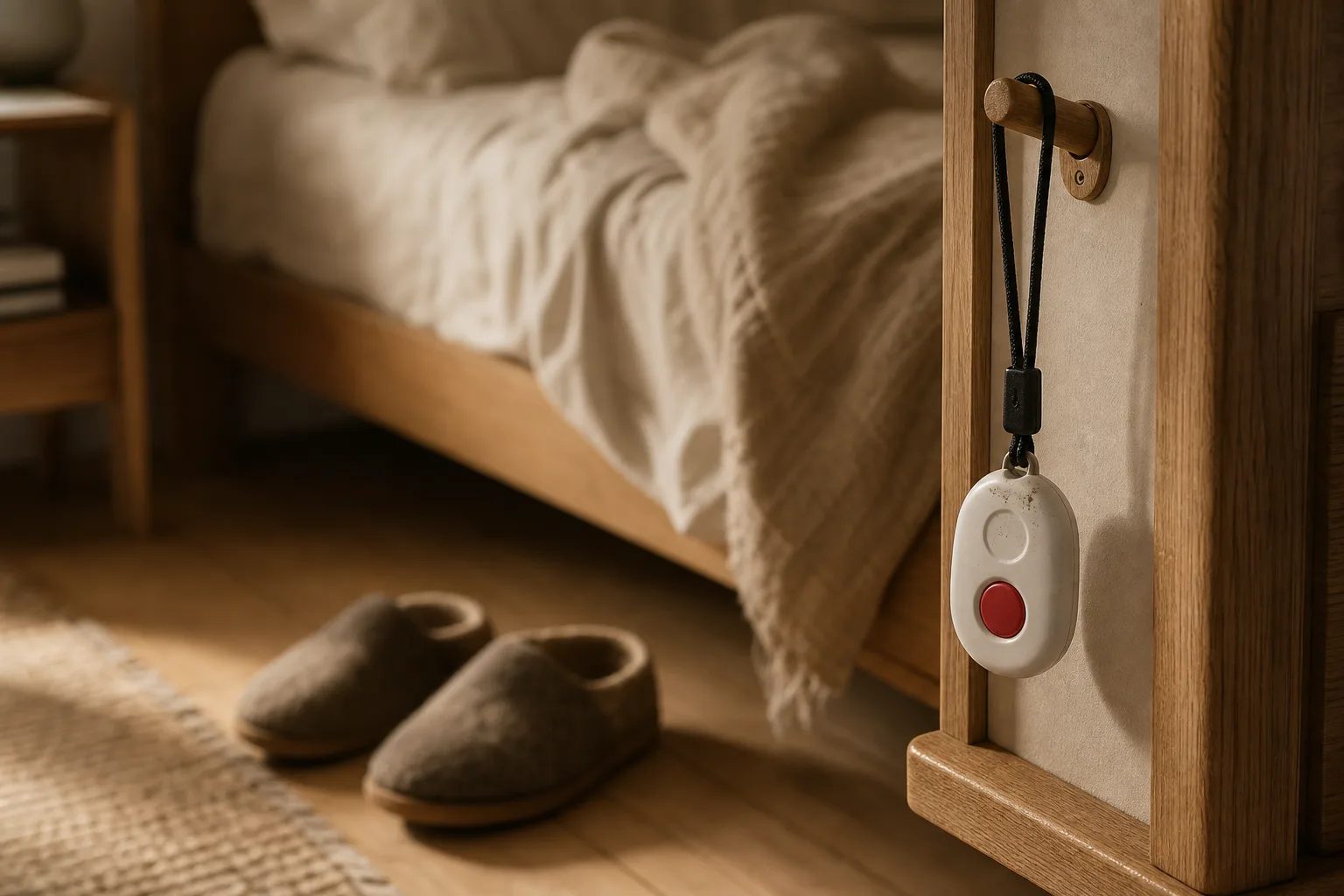
A daughter we spoke with did everything by the book: bought her mother a pendant alarm, paid the monitoring fee, practised pressing the button together at the kitchen table. Her mother wore it that afternoon. By the weekend it hung on the bedpost because, in her words, it made her feel like a patient. Fall detection without a pendant exists for exactly this house — the electronics were fine, and the plan still failed.
The fix is not a prettier necklace. At home, an installed sensor removes the two actions that keep failing: wearing and pressing. Away from home, a watch still earns its place. Below, one ordinary fall runs through every option, so you see where each breaks before you pay for it.
The alarm was there. Nobody pressed it.
Start with the scale. The CDC counts one in four adults over 65 falling every year. Tinetti's research in the New England Journal of Medicine adds the part families underestimate: most people who fall cannot get up again without help, and lying unhelped for more than an hour sharply worsens what comes after.
Now the number that should reshape your shopping list. A one-year BMJ study followed people over 90 and logged every fall. In 141 falls where the person was alone, unable to get up and had a call alarm available, it went unpressed in 80% of cases — 113 falls out of 141. Of the 38 falls that left someone down for over an hour, 37 happened with the button untouched.
That cohort was over 90, so take a second data point: another study of real falls found 97% of worn emergency buttons went unpressed. Different people, same result. Owning a button and pressing it mid-crisis are two different skills.
The interview research explains why. Recent fallers told researchers the pendant felt like a badge for somebody older than they are. They wanted to get up alone first. They were saving the button for a "real" emergency — while lying on the floor of one. Your mother is not careless. She is typical.
Run one fall through every option
Here is the test case. 2:07 in the morning, on the way back from the bathroom. A knee gives way and she folds slowly onto the bedroom carpet — no crash, no cry. Conscious, hurting, unable to stand. Nobody else in the flat.
Manual pendant
Helps only if worn — and pressed
On the bedpost: nothing happens, tonight or ever. On her chest: genuinely good. Lifeline and Medical Guardian staff live operators around the clock; the $25-45 a month they charge as of mid-2026 (rates drift — check before signing) pays those people, not the plastic. Everything hangs on two ifs.
Automatic watch
Detects hard falls — from the wrist only
An Apple Watch (SE, from about $250) recognises a hard fall, taps her wrist and calls for help if she stays still. Two catches. Most owners charge it overnight on the nightstand — the exact hours of the bathroom trip. And it is tuned for impact: a slow fold onto carpet often never reads as a fall at all.
Standard camera
Records everything, understands nothing
A €40 indoor camera captures the fall in full detail — for nobody. It cannot tell a fall from a nap, so no alert fires. Unless someone opens the feed at 2:07, the footage is evidence for the morning, not help in the night. And that is before your mother votes on a lens in her bedroom.
Installed radar
The room itself raises the alarm
A wall-mounted radar sensor reads radio reflections — position, posture, movement — with no lens and no image. Someone goes down and stays down; the system pushes an alert to your phone on its own. Nothing worn, nothing charged, nothing pressed. Its honest limit: it covers the rooms it is installed in, and not one step past the front door.
A pendant or a watch can still be the right call. Just be precise about the job each leaves to the person on the floor — and whether it gets done on the worst night of the year.
One caveat covers every automatic device, radar included. An umbrella review of fall-detection research found strong lab scores and thin testing on frail older adults at home. A staged fall onto a crash mat and a slow fold in a dark bedroom are different exams.
Fall detection without a pendant: match the tool to the missing action
The choice is simpler than the product pages pretend. If she refuses the necklace but tolerates a watch, buy the watch — then look at her wrist a week later. If nothing will be worn or charged, move the detector into the room. If she walks to the shops alone, keep a mobile layer too.
Swipe to compare all options →
| What matters | Installed radar | Automatic wearable | Manual alarm | Standard camera |
|---|---|---|---|---|
| What starts the alert? | The room detects a person down | A hard-fall motion pattern | A button press | Nothing — a human must be watching |
| What must the person do? | Nothing after install day | Wear it, charge it nightly | Wear it, reach it, press it | Accept a lens; someone opens the feed |
| Works away from home? | No | Yes, on cellular models | Only on mobile GPS models | No |
| Best fit | The homebody who wears nothing | A reliable wearer who goes out alone | Someone who wants control and will press | Visual check after another signal |
Our verdict: at home, installed radar is the cleanest pendant replacement because it deletes both failure points at once — wearing and pressing. Outside, a cellular watch wins. Many families run both: radar for the flat, watch for Saturday errands.
For prices and funding routes across every category, start with the main fall-detection device guide. The technology comparison grades each category in depth, the radar guide unpacks the signal processing, and if the lens is the real objection, read how to monitor an older parent without a camera.
Detection is half. Somebody must answer.
Automatic describes how an alert starts, not who gets out of bed for it. Every option above ends the same way: a notification on a phone. Walk that chain before you spend anything.
- DetectThe system recognises a person down in the bedroom.
- DeliverThe alert reaches your phone. Which is on silent. In another timezone.
- VerifySomeone calls her back before anyone is dispatched.
- EscalateNo answer within minutes? A second contact or an operator takes over.
- ReachSomebody holds a key — a neighbour, a lockbox — and knows when it is time for 112.
Run one drill: mute your phone for an evening and time how long a test alert sits unread. That figure is your real response time. No sensor on any spec sheet changes it.
Where OdeCare fits
OdeCare is built for exactly this case: a parent mostly at home who will not wear anything. We install camera-free radar sensors in the rooms that matter — bedroom, bathroom, hallway — and the system alerts your phone when someone is down and stays down. Between alerts, the family app shows the quieter signals worth a phone call: broken nights, more bathroom trips, slower mornings.
Three things we do not do. No cameras — the hardware has no lens, so footage of a bedroom cannot exist. No coverage outside the home — if your parent goes out alone every day, pair us with a watch, and we will tell you the same on a call. No lock-in — the fee is month to month, and cancelling is one email.