Fall Detection Devices Compared: Radar, Wearables, Cameras
Compare fall detection technology through one real fall: what radar, wearables and pendants detect, who gets alerted, and which fits your parent.
You arrived believing the name: a fall detection device detects falls, so the only question is which brand. It isn't. In one study of real falls, 97% of worn emergency buttons went unpressed — and a home camera records the whole fall without telling a soul. This fall detection technology comparison runs one fall — 2 a.m., between the bed and the door — through all four device types to show where each one breaks.
The short version: radar wins inside the home when your parent won't wear anything and won't accept a lens. A fall-detecting watch wins outside the front door. A pendant wins only when it's worn and pressed. A camera never wins — it's a viewing tool sold with a detector's vocabulary.
Detection is four jobs, and most devices do one
Four things have to happen for your mother to get off the floor: a sensor registers the fall, software decides it's real, an alert reaches a phone that isn't silenced, and a person acts. Product pages compress all four into one word — detection. Most devices do job one and gamble the other three.
- 1Sense
A sensor on the wrist or the wall registers the change.
- 2Decide
Software rules: a fall, or someone sitting down hard on the sofa.
- 3Alert
A phone rings, an app fires, or an operator answers.
- 4Respond
Somebody calls back, drives over, or sends an ambulance.
The stakes of a broken chain are documented. The CDC counts one in four adults 65 and over falling each year, and Tinetti's New England Journal of Medicine work found that most fallers can't get up without help — and that lying unhelped for more than an hour sharply worsens what happens afterward. A device that senses the fall but drops the chain at step three produces the same night as no device at all.
The same 2 a.m. fall, four different endings
Hold the event fixed. Your mother falls between the bed and the bathroom door. She's conscious, can't push herself up, and doesn't shout. Change nothing but the technology in the room.
Best passive option at home
Radar: the wall notices, and nothing films her
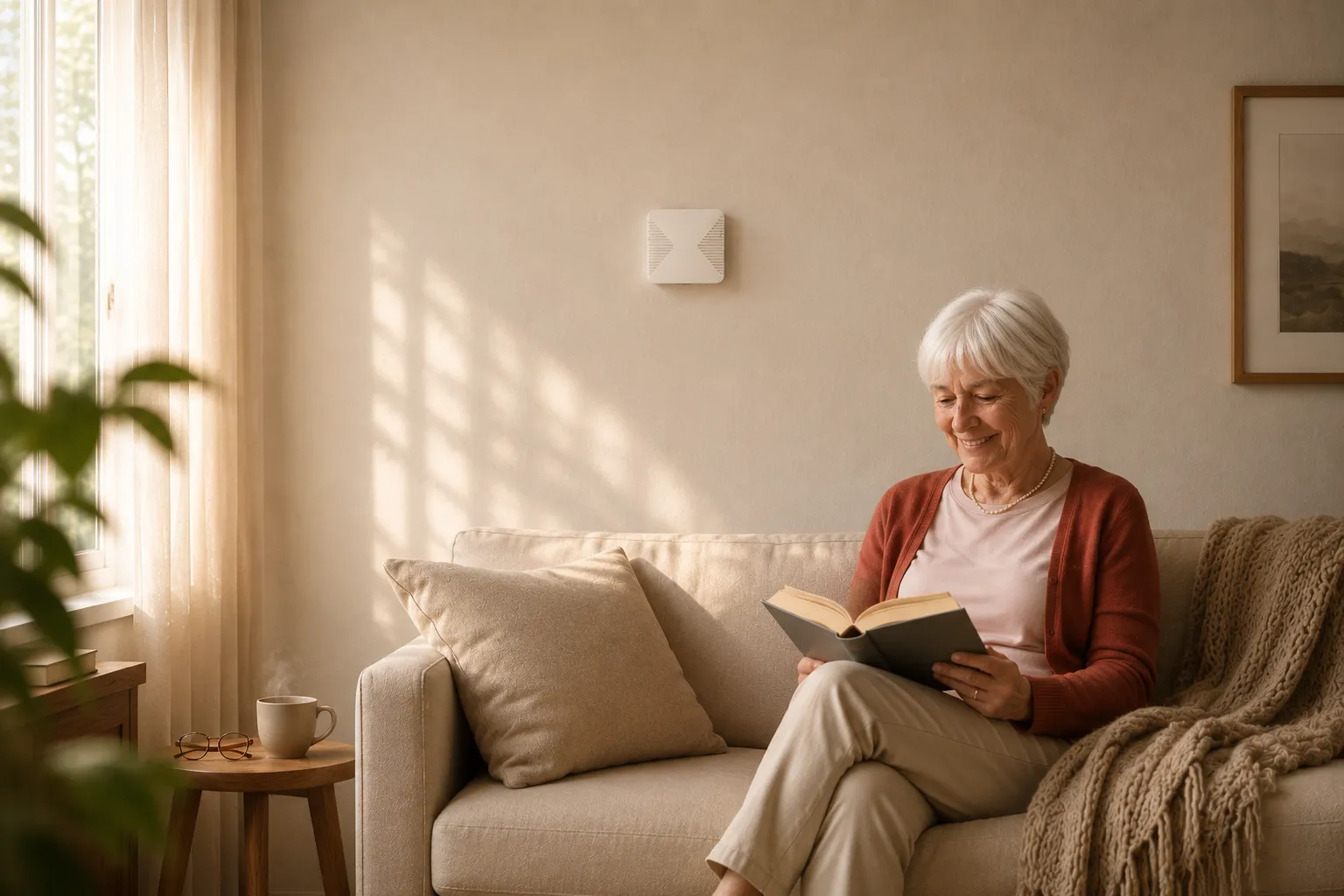
A sensor the size of a smoke detector reads radio reflections off the room — devices in this class include Vayyar Care and OdeCare's kit. A body down on the floor that stays down produces a pattern the software is built to catch, and the alert goes out on its own. She wears nothing, presses nothing, charges nothing.
The trade is plain: radar covers the rooms it's installed in, not one step beyond, and it needs power and Wi-Fi. What it never needs is a lens — which is why it's usually the only technology a private person will tolerate in the bedroom and the bathroom.
Best outside the front door
A watch goes where she goes — if it's on her
An Apple Watch (Series 4 onward) ships with hard-fall detection: it senses a hard fall, waits about a minute for movement, then calls emergency services and texts her emergency contacts with her location. Mobile medical-alert wearables from firms like Medical Guardian route the same event to a human operator instead. It's the only category here that covers the walk to the pharmacy.
At 2 a.m. it covers nothing, because most watches spend the night on the nightstand, charging. That's the quiet failure of wearables: the falling hours and the charging hours are the same hours.
The button
A pendant waits for a press that rarely comes
A monitored pendant — Lifeline, Life Alert, Bay Alarm Medical, and a hundred look-alikes — turns a button press into a call with a trained operator, typically for $25-45 a month as of mid-2026; check the current rate sheet before you sign. At its one job it is genuinely good: deliberate press, human voice, help dispatched.
The weak link is the press itself. In a prospective study of people over 90, fallers who were alone and couldn't get up mostly never used the alarm they had — they waited to be found. People don't press because they're winded, embarrassed, or sure they'll manage in another minute.
A daughter we spoke with thought she'd solved this twice — one pendant, then a replacement after the first went "missing." Changing the sheets one weekend, she found both looped over the bedpost, where her mother hung them every night before getting in.
The accuracy number was measured in a different world
Every spec sheet leads with an accuracy figure. Ask where it was earned. A systematic review of fall-detection research found that only 7.1% of wearable projects had monitored older adults in a real-world setting — the rest measured young volunteers dropping onto crash mats. Among non-wearable projects, not one had been evaluated on older adults at all.
That review reached back through 2013, and a later umbrella review of wearable devices found high sensitivity across lab studies while still calling for real-world evidence in frail older people. A scripted jump is not a real fall — sideways off the edge of the bed, half-caught by the nightstand, in the dark. Lab numbers don't survive the trip into a furnished house with a cat.
Fall detection technology comparison
One question per row: after you've paid, what still has to go right? Each technology leaves one dependency standing — pick the one your parent can live with.
Swipe to compare all four technologies →
| Decision | Radar | Automatic wearable | Manual alarm | Standard camera |
|---|---|---|---|---|
| What starts an alert? | A body down on the floor — no press, no wearing | A hard fall the watch recognizes | A button press | Nothing — a person must open the feed |
| Must the person wear or press? | No | Wear it and charge it nightly | Wear it, reach it, press it | No |
| Must somebody watch video? | No lens exists | No | No | Yes — that is the whole mechanism |
| Works away from home? | No | Yes, with cellular service | Only on mobile models | No |
| How it actually fails | The room you didn't cover | On the charger during the fall | Worn but never pressed | Recorded but never seen |
Read the last row twice — it's this whole article in one line. Radar fails by geography. The watch fails by schedule. The pendant fails by psychology. The camera fails by design. Only the first is fixable with money — one more sensor.
Choose by the life around the device
Mostly home, refuses wearables and cameras
Radar, starting with the bedroom, bathroom and living room. This is the one profile where nothing else works, because everything else needs her cooperation at the worst possible moment.
Still out every day
An Apple Watch or a mobile medical alert he'll actually wear comes first. Add radar at home if the watch comes off at night — check the nightstand, not his promise.
Wants to stay in charge
A monitored pendant respects that. Test it from the garden and the shower, and agree in advance what everyone does on the day she can't press it.
A camera is already up
Keep it for reassurance calls, not detection. Decide who's allowed to open the feed, and pair it with radar or a wearable for the actual alert.
The main fall-detection device guide covers the full buying decision, including funding. The situation-based guide matches device types to daily routines in more depth. For the physics, read the radar explanation; and if the pendant already lost the argument at your kitchen table, go straight to fall detection without a pendant.
Run one drill before you trust anything
Whatever you pick, spend twenty minutes on a drill before you rely on it. Use the vendor's test mode — never stage a real fall — and follow the alert with a stopwatch until a human being completes an action.
- RoomStand on the exact spot of the last fall or near-fall. Is that spot inside the installer's coverage plan?
- EventFire the test event. Write down what triggers an alert — and what the manual admits never will.
- DeliveryWhose phone rings? Silence that phone and run the drill again.
- OwnershipWho calls back, who drives over, and in what order — names, not roles.
- EscalationHave the first contact ignore the call on purpose. Time the gap until the second phone rings.
Log four timestamps: detected, delivered, acknowledged, resolved. The fall-detection pilot guide turns this into a two-week protocol that counts misses and false alarms instead of quoting the box.
Where OdeCare fits
OdeCare is the radar column of that table. We install camera-free wall sensors in the rooms you choose; when someone is down on the floor, the alert goes to the family on the response plan — with a monitored option where an operator calls the resident first, then the family, then emergency services. Between alerts, the app shows the quiet signals: how the night went, how often she was up, whether today's rhythm looks like hers.
Three things we don't do. No cameras and no microphones in any room, ever — there is no lens in the hardware to switch on. No coverage beyond the walls — if your father walks alone every morning, put a fall-detecting watch on his wrist and let us take the nights. And no lock-in — after the included months, it's month to month.