How Radar Fall Detection Works: From Reflection to Alert
How mmWave radar fall detection turns radio reflections into a phone alert: what the sensor measures, what 60 GHz means and how to test it.
How does a small disc on the wall know your mother has fallen — no camera, nothing on her wrist, nothing to press? That is the question radar fall detection exists to answer, and here is the honest version: the sensor never sees her. It fills the room with radio waves and reads the reflections coming back, thousands of times a second. When those reflections do what a body does only on its way down — drop fast, stop low, stay low — software raises its hand.
The stakes behind the gadget are blunt. The CDC counts a fall every year for one in four adults over 65. The classic answer, a pendant button, fails at the exact moment it exists for: in one study, 97% of worn emergency buttons went unpressed in real falls. Radar removes the pressing. What it can't remove is the engineering between an echo and a ringing phone — and that middle stretch is where good and bad products part ways.
To keep this concrete, we'll follow one fall through the whole chain. Your mother gets up from her armchair to answer the doorbell. Two steps in, her knee gives. She catches the chair back, slows herself, and folds onto the carpet — no crash, no cry, just a quiet room with a person on the floor of it. Hold that scene. Every section below does one job on it.
The sensor hears an echo, not a fall
Start with what the hardware actually receives. The disc above the living-room door transmits frequency-swept radio pulses — engineers call them chirps — and measures what bounces back. The wall answers. The bookshelf answers. Your mother answers. The raw return is a pile of overlapping reflections, and nowhere in that pile is the word "fall."
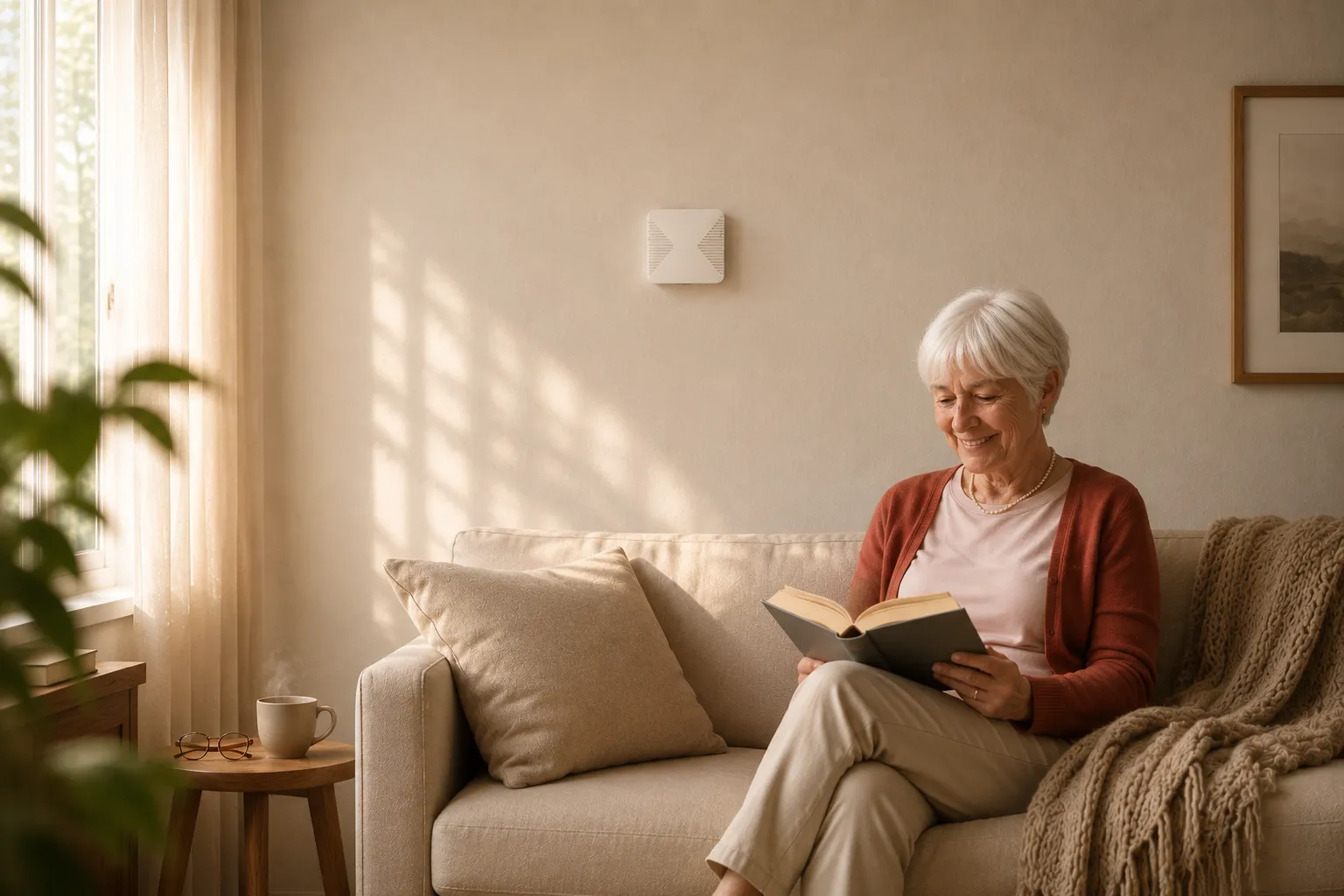
Everything useful is inference stacked on that echo. Signal processing turns raw returns into estimates: where the moving thing is, how fast, how high off the floor. Product software turns estimates into events. A service turns events into a human picking up a phone. Break any link in that chain and the fall stays a secret.
This is why "radar" on the box tells you almost nothing by itself. A 2024 survey of 74 papers and studies on radar-based fall detection catalogued systems built on micro-Doppler signatures, range-Doppler maps and full 3D point clouds, fed into everything from hand-tuned thresholds to deep neural networks. Same word on the box. Different machine inside.
What radar fall detection actually measures
Most indoor sensors use FMCW radar — frequency-modulated continuous wave, the same technique a car's adaptive cruise control uses to hold distance on the motorway. Instead of taking a picture, the chip compares outgoing and returning waves and extracts four things:
Range
Distance to the reflection. Her signal sits three meters out — by the armchair, not by the window.
Velocity
Speed toward or away from the sensor. A stroll reads as walking pace; a dropping torso briefly outruns it several times over.
Angle
Where in the room the return sits, resolved by an array of small antennas on one chip.
Change over time
The track: dropped, stopped, stayed at floor height, rose again — or didn't.
Texas Instruments' mmWave reference design, built on its IWR6843 chip, shows this pipeline running end to end: chirps in, moving point cloud out, fall flag raised. It proves the mechanism is real. It says nothing about how the specific product on your wall was tuned, mounted or trained — that gap is the whole rest of this article.
The fall is a sequence, not a pose
Here is the hard part. When your mother's fall ends, she is sitting on the carpet — the exact posture of a grandmother sorting a box of photographs. A single frozen frame cannot tell those two apart. The sequence can: how fast her height dropped, from where, whether motion stopped, how long the low position held, and what she was doing the second before.
- 1Strip the furniture
Static-clutter removal deletes everything that never moves. The armchair vanishes from the data. She doesn't.
- 2Track the mover
The remaining reflections get grouped into one target and followed frame to frame across the room.
- 3Build the sequence
Standing height by the chair, a fast drop to floor level, then stillness — time-stamped, in order.
- 4Ask the model
Rules or a trained classifier compare that sequence against the falls the product was taught. Sitting down slowly doesn't match. This does.
- 5Route the event
The service pushes the alert to whoever is configured to act: your phone, a staff pager, a monitoring desk.
Every accuracy percentage you will ever read belongs to that whole pipeline in one exact configuration — this antenna layout, this mounting height, this training data, this definition of "fall." The same 74-study survey praises the field's progress and flatly names its weakness: the gap between lab results and real homes. Young volunteers falling onto mats on cue are not older adults folding quietly between real furniture.
"60 GHz" is a radio band, not a quality badge
Spec sheets lean hard on that number, so here is what it actually buys. At 60 GHz the wavelength is about five millimeters — hence "millimeter-wave" — fine enough to resolve tiny motions; it is the same band Google's Nest Hub uses to track breathing during sleep, no camera involved. And 60 GHz barely passes through walls: the sensor covers the room it is in and goes deaf at the drywall. For a bedroom device, that is a feature, not a limit.
What the band tells you: the physics — millimeter-scale resolution, single-room reach — and which rules govern the radio: the FCC's 60 GHz rules in the US, and the ICNIRP radio-frequency guidelines for exposure from 100 kHz to 300 GHz.
What it can't tell you: whether the product recognises the slow, quiet falls that happen in your mother's living room. Two sensors in the same band, with different antennas, mounting and training data, detect different falls.
Test the room like you're trying to fool it
A clean showroom demo proves exactly one thing: the pipeline recognises the fall it was shown. Your job is the opposite. Spend a week trying to fool the system in the actual room, before anyone relies on it.
Map the dead zones
Walk the far bed side, the doorway, the corner behind the wardrobe. Note where coverage ends. Then move a bookcase and test again — furniture reshapes the radio picture.
Fake a fall's neighbours
Sit down fast. Kneel to reach a low shelf. Lie on the floor to stretch your back. These are the everyday moves that live one threshold away from an alert.
Add the household
The cat on the bed. Two people talking in the kitchen. A visiting grandchild. An oscillating fan. Multi-person rooms are where radar trackers work hardest.
Cut the cord
Pull the plug for ten minutes. Kill the Wi-Fi. Ignore the first notification on purpose. Detection, delivery and response are three separate failures with three separate fixes.
A daughter we spoke with ran exactly this gauntlet in her father's flat: a week of kneeling at low cupboards, sitting on the floor to sort boxes, letting the dog nap inside the sensor's zone — and once, deliberately, ignoring an alert to see who called next. What the system did that week taught her more than the brochure had.
Whatever you find, write it down: sensor model, firmware version, room, mounting height, what you did, what fired. The fall-detection accuracy guide turns those notes into a proper pilot. One safety rule stands above all of it: use the vendor's safe test mode, and never ask an older person to perform a fall.
Why the response half deserves equal testing comes from Mary Tinetti's research in the New England Journal of Medicine: most people who fall cannot get up without help, and lying unhelped for more than an hour sharply worsens what happens afterwards. The radar decides whether anyone finds out. The alert path decides how long she waits.
Still choosing a technology rather than validating one? Start with the technology comparison or the guide to fall detection without a pendant; the full fall-detection device guide covers the buying decision end to end.
No camera doesn't mean no data
Radar's privacy win is real. There is no image to leak and no feed for a relative to open at a bad moment. What the bedroom sensor produces is closer to a weather chart than a photograph — moving points in space, no faces, no skin, no room interior.
But the system still generates data: presence, movement, position estimates, room events, weeks of activity history. A serious vendor answers five questions without flinching: what stays on the device, what leaves the house, where it is stored, who can open it, and when it is deleted.
And camera-free is not consent-free. Your mother should know the disc on the wall exists, what it watches for, and who gets called. Monitoring someone in secret poisons the trust the entire system depends on — and she is the one who has to live under it.
What we built at OdeCare
OdeCare is this whole chain, assembled and running. Wall-mounted radar sensors in the rooms where falls actually happen — bedroom, bathroom, hallway — plus the software that turns reflections into events, and a family app that shows what matters: sleep, night wake-ups, the tempo of the day, and alerts for the events the system supports. Where partner monitoring is included, a live operator calls your parent first, then you, then — under the plan you agreed in advance — the ambulance. Nothing worn. Nothing charged. Nothing pressed.
Three things we don't do: we don't sell cameras and won't put one in a bedroom, ever. We don't make your parent wear or charge anything. And we don't lock you into a contract — the monthly fee stops the day you say stop.
As for the scene this article opened with: that quiet fold onto the carpet — no impact, no cry — is precisely the fall this pipeline exists to catch. The doorbell went unanswered. The sensor didn't.