Fall Prevention Devices for Elderly: Room Guide
Room-by-room fall prevention devices for elderly parents: grab bars, rails, lighting, fall mats and footwear, with mid-2026 prices and the one gap no.
Discharge day. The nurse hands you a photocopied home-safety checklist while your mother waits in a wheelchair by the sliding doors — fourteen bullet points, no prices, no order to do them in. This guide is that sheet done properly: fall prevention devices for elderly parents, room by room, with mid-2026 prices, and an honest answer to the one problem no grab bar solves.
Fall prevention devices for elderly parents: two different jobs
The CDC counts one in four adults over 65 falling every year, which is why the search results for this topic are a mess. Half the products are prevention — grab bars, rails, lights, footwear, each removing one specific hazard. The other half are detection — pendants, watches, room sensors, all dealing with the fall that happens anyway. Different jobs, different budgets. This page covers prevention; our fall detection guide compares the other side.
Work in this order: bathroom, stairs, bedroom, living areas. Falls cluster at transfers — on and off the toilet, over the shower threshold, the first and last stair, the edge of the bed. A dollar spent at a transfer point buys more safety than a dollar spent anywhere else.
Two free fixes before you spend anything
CDC's STEADI program puts hardware last for a reason. The two highest-yield fixes are free. First, a medication review: blood-pressure pills, sleep aids and anything sedating are the classic causes of dizziness on standing; a pharmacist will go through the whole bag in one visit. Second, vision: bifocals blur the floor exactly where the eyes point when walking downstairs, and an outdated prescription does the same on flat ground. Our fall risk assessment guide shows how to set both up before the shopping trip.
Bathroom: grab bars, non-slip surfaces, seats
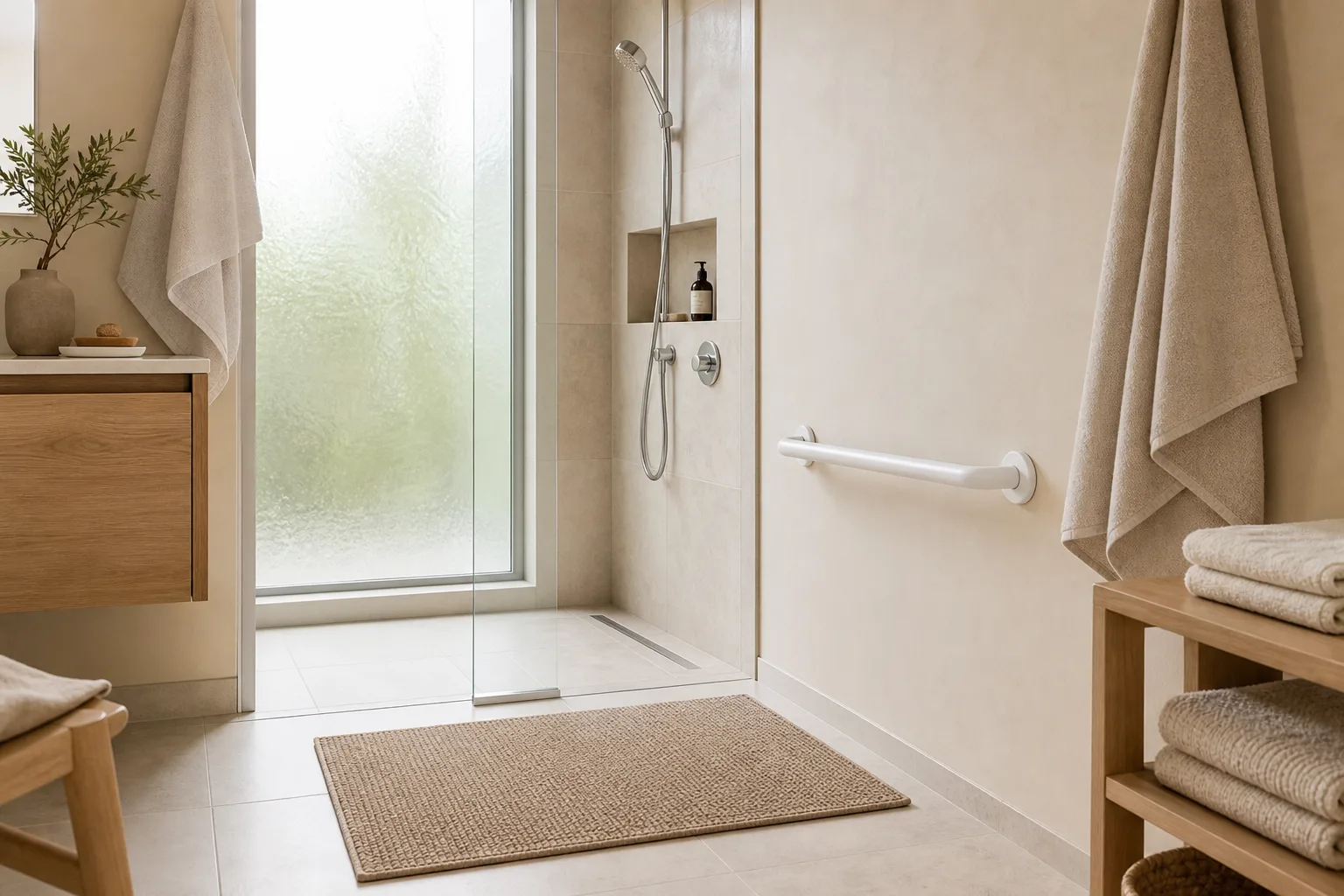
Water, bare feet and porcelain share forty square feet, so the bathroom goes first. Fit it around two moves: on and off the toilet, in and out of the shower.
- Grab bars. An ADA-spec stainless bar holds 250 pounds. Hardware is $25-40; a handyman anchoring it into studs brings the total to $100-150 per bar. One vertical bar at the shower entry, one beside the toilet. Suction-cup bars are for steadying a hand, never for body weight — they let go without warning.
- Non-slip surfaces. Textured strips inside the tub, a low rubber-backed mat outside it. Anything with a curling edge gets thrown out, not repositioned.
- Raised toilet seat. $40-80 adds three to four inches; versions with push-off arms do more work than the height. Clamp-on models wobble — buy one that bolts to the pan.
- Shower chair or transfer bench. A basic chair runs $30-60. For a tub, a transfer bench ($60-120) is better: your parent sits outside the tub and swings their legs over instead of stepping across the wall.
- Handheld shower head. $25-50 on a slide bar turns seated bathing from awkward into normal.
Stairs and hallways: rails, treads, edges
Before buying anything, walk the flight behind your parent and watch their hands. Wherever a palm touches the wallpaper, a rail belongs.
- Handrails. Most staircases have one rail; most older hands want two. A carpenter fits a second rail on a straight flight for $200-500, mounted 34-38 inches above the treads and running past both the top and bottom step.
- Secure treads. Re-tack loose carpet and screw down creaking nosings before adding anything on top. A $5 tube of adhesive under a lifting stair edge beats a $50 gadget on a loose one.
- Edge contrast. A strip of contrasting tape or paint on each nosing makes the step boundary visible to older eyes. Skip patterned runners — a busy pattern hides the exact line the eye is hunting for.
- Lighting at both ends. A switch at top and bottom, bright bulbs, no shadow across the middle steps.
Bedroom and the night route
Walk the bed-to-bathroom route in the dark yourself. Daylight hides a slipper mid-floor, a trailing phone cable, a doorway that swallows the light.
- Motion-sensing night lights. Plug-in motion lights cost $10-20 each; three cover a typical route — bedside, hallway, bathroom. Battery models from Mr Beams go where there is no outlet.
- Bed at a suitable height. The test: sitting on the edge, feet flat, knees at a right angle. Higher and the feet dangle; lower and standing becomes a lunge. Fix it with a different frame or mattress, not stacked blocks.
- A reachable bedside table. Glasses, phone, water and a lamp within arm's reach — every item that isn't is one more reason to get up in the dark.
- Bed rails, with a serious caveat. A full-length rail leaves a gap between rail and mattress that has trapped sleeping adults; portable versions keep getting recalled for it. For push-off help, a short transfer handle bolted to the frame gives the grip without the gap. If your parent has already gone over the edge once, read what to do after a bed fall and our bed alarms guide first.
What fall mats do and do not do
A bedside fall mat ($60-150) is crash padding, not prevention. It lowers the cost of hitting the floor and does nothing about arriving there. It serves one case well — the sleeper who rolls off the mattress. Put the saved effort into finding out why the rolling happens.
The mat's own edge is the tax. An inch of foam beside the bed sits exactly where a waking foot lands, so choose a bevelled-edge model, push it flush against the bed frame, and take it up the day it starts to curl.
Hip protectors and footwear
Hip protectors are underwear with pads stitched over the hip bones, $40-90 a pair. The trial evidence is strongest in nursing homes and weakest at home, for a blunt reason: they only work while worn. Buy three pairs or none — one pair is permanently in the wash.
Footwear: firm sole, closed heel, a fastening that cinches. Backless slippers appear in more fall stories than ice does. Thick cushioned trainers feel safe but mute the floor; a thinner, firmer sole tells the foot where it stands.
Living room and kitchen: the cheap fixes
Almost everything here costs less than a dinner out:
- Rugs: throw rugs go, or get double-sided carpet tape on every edge. The rug that has "always been there" is the one nobody sees anymore.
- Cords and clutter: cables routed along the skirting boards, walking paths cleared to a full shoulder width.
- Chair height: a firm chair with arms, seat at knee height. A deep soft sofa turns standing up into a rocking launch.
- Kitchen reach: daily plates and cups shelved between hip and shoulder height. The step stool leaves the kitchen for good.
- General lighting: swap in 100-watt-equivalent LED bulbs at a few dollars each. A 75-year-old retina needs roughly three times the light a 25-year-old's does, and most parents' houses are still lit for the person who moved in decades ago.
Fall alarms for elderly parents: the backstop, not the plan
A daughter we spoke with spent a weekend fitting her father's house — two grab bars, a second stair rail, three motion lights. His next fall happened in the middle of the living room, two steps from anything she had installed. Her work wasn't wrong. Falls don't only happen next to walls.
That is the honest limit of every device above, and why alarms exist — but read their fine print too. In one study of real-world falls, 97% of worn emergency buttons went unpressed: taken off for the shower, or the faller was stunned, or determined to manage alone. Pendant makers admit in their own manuals that automatic detection misses falls — especially the undramatic kind: the knee folding mid-turn, the sit that misses the chair. A monitored pendant runs $25-45 a month as of mid-2026. Whichever route you take, rehearse the chain — who gets the call, who holds a key — with our guide on what to do after a fall.
What the whole house costs
Priced as one project, the full list is smaller than most families fear. Mid-2026 ballparks:
| Work | Typical price | Notes |
|---|---|---|
| Bathroom: two bars installed, raised seat, transfer bench | $350-500 | The installer visit is half the cost |
| Stairs: second rail fitted, nosing repair, lighting | $250-550 | Straight flight; turns cost more |
| Bedroom night route: three motion lights, transfer handle | $60-120 | An afternoon of DIY |
| Living areas: tape, bulbs, cord tidying | Under $50 | One hardware-store trip |
| Hip protectors, three pairs | $120-270 | High fracture risk only |
Call it $800-1,500 for a typical house, nearly all one-time. Before paying, see what someone else will fund. In England, a council occupational-therapy assessment usually ends with small adaptations fitted free; the Disabled Facilities Grant covers bigger work. In the US, some Medicare Advantage plans carry a home-safety allowance, and veterans have the VA's HISA grant. Rules differ by plan and council — get the answer in writing before you buy.
Prevention lowers the risk. It never removes it.
Here is the promised hard part. Tinetti's New England Journal of Medicine research found that most older adults who fall can't get up again without help — and that those left unassisted for more than an hour fare markedly worse in the months that follow. Grab bars shorten the odds of the fall; they say nothing about how long someone lies there afterwards. So a finished prevention plan ends with one more question: when a fall happens anyway, how does anyone find out?
That question is the one OdeCare answers. We mount radar sensors in the rooms where it counts — bathroom, bedroom, hallway — and they notice when a person goes down and stays down, then alert your phone. No cameras, so the bathroom stays a bathroom. Nothing worn, so there is no button to forget in the shower. Three things we don't do: we don't prevent falls — that is what this whole page was for; we don't dial emergency services for you — you see the alert and make the call; and we don't run through a power or internet outage, because the hub needs both.