Parent Refuses a Medical Alert? Find the Real Objection
When a parent refuses a medical alert, stop selling the pendant. Find the real objection, use a calm script and choose an alternative they accept.
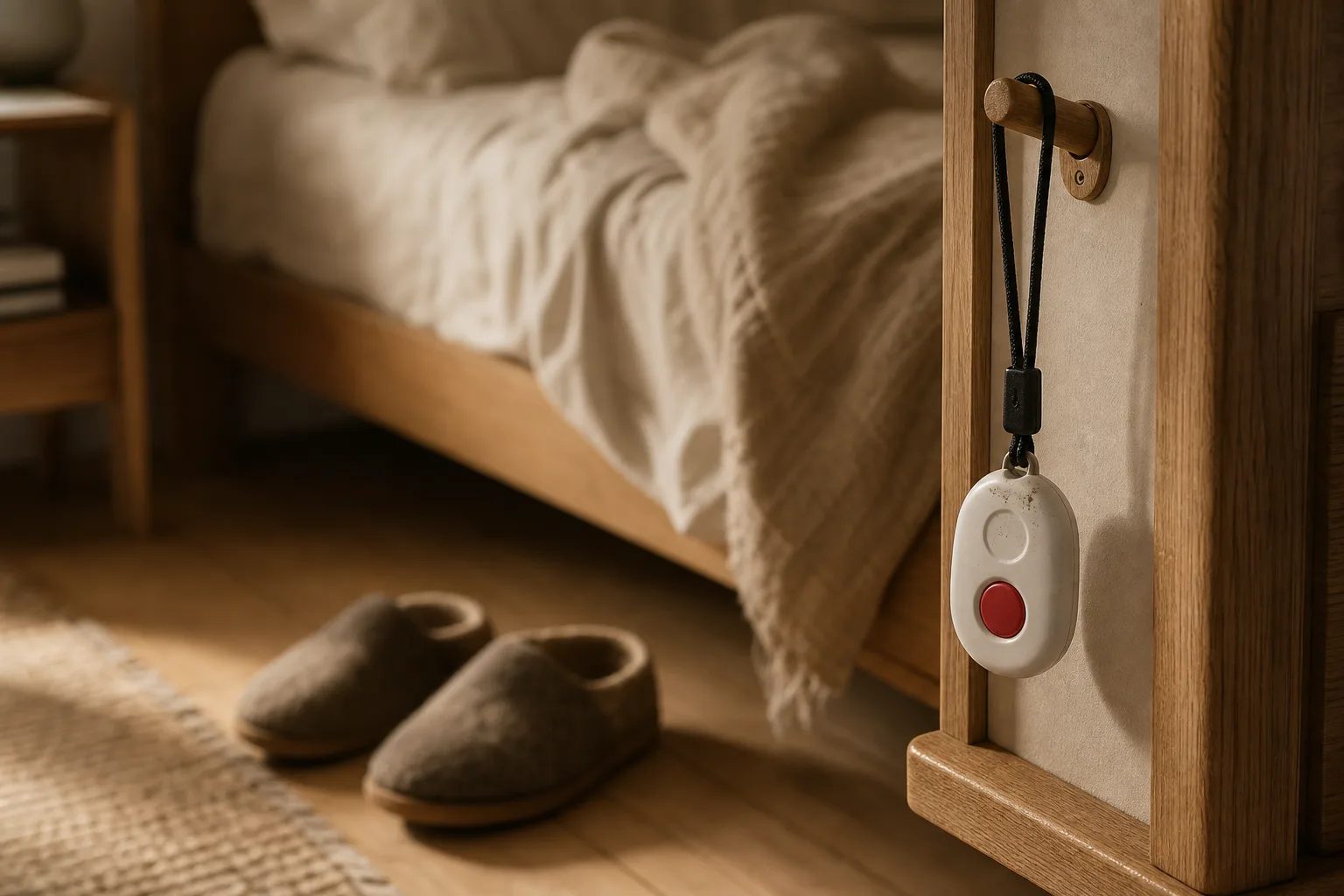
Saturday afternoon, your mother's kitchen. The kettle is on, and the medical alert pendant you researched for three weeks hangs off a cup hook next to the oven mitts. It was there last visit too. This is how a parent refuses a medical alert: no argument — the pendant just never reaches the neck.
Skip the next safety lecture; it has already lost. The refusal is information. Behind it sits one of five objections — looks, routine, cameras, range, or monitoring itself — each with a different fix. This page shows you how to find yours.
When a parent refuses a medical alert, the no is information
A study of how older people adopt personal alarms found the decision is never just an equipment choice. Your parent has to admit a need, agree the time has come, and square the device with the person they still believe themselves to be. You are talking about response times. They are hearing a demotion.
One fact should cool both sides: the pendant is weaker than it looks. In one study of real-world falls, 97% of emergency buttons that were being worn went unpressed. People feel embarrassed, decide to manage alone, or land with the button pinned underneath them. Winning the wear-it fight wins less than you think.
Interviews with older people who had recently fallen sorted them into three camps: committed wearers, maybes, and owners of an alarm that lived on a shelf. Their reasons were concrete — the cord chafed, the button confused them, the need felt hypothetical, asking for help felt like the first step out of their own house. Different reasons need different fixes — hence questions before products.
Ask four questions before you buy anything else
A daughter we spoke with found her father's pendant looped over the banister every visit — not lost, promoted to decoration. When she finally asked what he hated, it wasn't pride: the cord itched through his shirt, and the clasp was too small for his thumbs. Weeks of arguing about dignity, and the problem was a fastener.
Question one
“What do you hate about this one?”
Listen for a noun: the cord, the button, the charging cradle, the stranger who answers, the monthly bill. “I just hate it” is the opening bid, not the answer. Keep asking until you get hardware.
Question two
“What do you think happens when it goes off?”
Some picture an ambulance for every false alarm; others, the family tracking them all day. Walk through the real chain — operator first, then you, ambulance last — and ask if that is acceptable.
Question three
“Where do you most want to stay independent?”
Sleeping in their own bedroom. Bathing without an audience. The walk to the bakery. Name the goal first; pick the least intrusive device that defends it.
Question four
“What would you try for one week?”
A seven-day trial is reversible; a device feels like a verdict. Agree in advance what counts as failure — false alarms, itching, feeling watched — and honour it if they call it.
While you diagnose, drop the word “stubborn.” A clasp too small for arthritic fingers is a design defect, not a character flaw.
Use a script that gives control back
Pick an ordinary moment — the kitchen table after lunch, not the emergency-department corridor after a scare. You want one honest sentence out of them, not a signature.
You: “I'm done nagging you about the pendant. I just want to know which part is worst — how it feels, what it says about you, or what happens after you press it?”
Parent: “I don't want people checking on me all day.”
You: “Fair. I don't want to watch you either. I want one thing: if you go down and can't reach the phone, someone finds out the same day — not on Thursday. Can we rule out cameras completely and compare a watch, a wall sensor and a plain call schedule? You veto anything that feels worse than the risk.”
The script has one job: split the shared goal from your preferred gadget. “Help arrives without filming the bedroom” is a goal two people can hold at once. Said out loud, it lets a watch, a sensor and a phone schedule compete on merit instead of on who is winning.
If every attempt collapses into the same fight, the wider playbook is our guide to talking to an older parent about home safety. This page stays on the refused alarm.
Match the alternative to the objection they named
| The real objection | Try this direction | The honest boundary |
|---|---|---|
| “It makes me look old” | A watch they'd wear anyway — Apple Watch and Samsung Galaxy Watch both ship fall detection — or wall sensors nobody sees | The watch must be worn and charged every night; wall sensors stop at the front door |
| “I keep forgetting to put it back on” | Passive radar sensors installed in the bedroom, bathroom and hallway | Room-by-room coverage; needs mains power and Wi-Fi |
| “I will not have a camera in my house” | Radar or ambient sensors — they register movement, not images | You get alerts and patterns, never footage |
| “But what about when I'm out?” | A mobile alarm with GPS, or the watch again | Wearing and charging come back with it |
| “I don't want to be monitored at all” | A key safe, grab bars, a standing daily call, a written missed-check-in plan | If they fall alone, nothing will know automatically |
Two rows still end in a monitored pendant — the right answer if the objection was this device, not the category. A staffed service typically runs $25-45 a month as of mid-2026 (verify before you sign); the fee pays for operators on shift around the clock. See our guide to personal alarms for older people. If the button itself is the dealbreaker, compare fall detection without a pendant. The Life Alert alternatives guide walks the full buying decision.
If it's still no, name the gap out loud
A capable adult is allowed to refuse monitoring. Your father is not a project, and installing sensors behind his back is not a compromise — it is the surveillance he refused, minus the honesty.
So take the smallest layer he will accept and bank it: a brighter bulb over the basement stairs, a grab bar by the tub, a key safe on the porch, a standing morning call plus a written rule for a missed one. Small layers are not nothing. The CDC counts a fall every year for one in four adults over 65, and Mary Tinetti's research in the New England Journal of Medicine found that most people who fall cannot get up unaided — and that lying unhelped for more than an hour sharply worsens what comes after.
Then say the remaining gap plainly: “If you fall when no one is due, nothing alerts anyone.” Harsh — but kinder than letting an unworn pendant stand in for a plan.
One boundary: if the refusal comes with new confusion or changed judgement beyond this device, take the pattern to their doctor — not to a family vote about capacity.
Where OdeCare fits
OdeCare exists for exactly this refusal: a parent who accepts help at home but rejects wearing, pressing and filming. We put small radar sensors on the walls of the rooms that matter — bedroom, bathroom, hallway. Nothing to wear, charge or remember. The family app shows the day against their normal rhythm: up around the usual time, kitchen at lunch, a quiet night. When the pattern breaks — a fall, or stillness where there should be movement — you get an alert, not a discovery days later.
And three things we don't do. We never record video — there is no lens in the box to disable. We don't follow anyone outdoors — coverage ends at the walls, so the bakery walk still needs a phone or a watch. And we cannot see through a dead router: the system runs on mains power and home Wi-Fi.