Personal Alarms for the Elderly: A Plain Guide
Personal alarms for elderly people: pendant vs wrist, monitored vs autodial, real 2026 prices, free UK and US routes, and the 97% problem nobody mentions.
A monitored personal alarm runs about £15–25 a month in the UK and $25–45 in the US as of mid-2026, with the pendant itself usually thrown in — verify the renewal price before signing, because the teaser rate rarely survives year one. That is the easy part of shopping for personal alarms for the elderly.
The hard part is a number no brochure prints: in one study of real falls, 97% of worn emergency buttons were never pressed. Not broken. Not out of range. Worn, working, and not pressed. Hold that number — the last two sections of this guide deal with it directly.
In between: what the category actually is, pendant versus wrist, monitored versus autodial, what things cost, and the free routes in the UK and US.
What a personal alarm actually is
Under every brand name, the machine is the same: a radio button worn on the neck or wrist, and a base unit plugged in near the router. Press the button and the base unit opens a speakerphone line — to a staffed response centre if you pay monthly, or down a list of family numbers if you bought an autodial unit. The whole category is a doorbell that dials out.
The names change at the border. In the UK it is a personal alarm, pendant alarm, community alarm, careline, or telecare. In the US, the same kit is a medical alert system or PERS — personal emergency response system, and the paperwork from a discharge planner or insurer will usually say PERS. A GPS mobile variant swaps the base unit for a cellular chip: it works at the shops and on the bus, and it needs charging like a phone.
One test before the return window closes: press the button from the bathroom with the door shut, then from the far end of the garden. The range printed on the box was measured in open air, not through two brick walls and a boiler cupboard.
Pendant alarm or wrist button: which one gets worn?
A pendant sits on the chest where either hand reaches it, on a breakaway cord designed to snap open rather than catch on a door handle. Its failure mode is social, not technical: it looks medical, so it goes under the cardigan for church, then onto the bedside hook, then into a drawer.
A wrist button reads as a watch, which is why people who wear watches keep it on. The test that matters: pressing it with the opposite hand while lying on the floor, and fastening the strap alone with stiff fingers. Run both during the trial period, not after it.
Whichever form wins, it has to survive the shower — wet tiles are where falls live — so read the exact water rating, not the word "splashproof" on the lid. And let your parent pick. A device chosen for someone stays on the hook. A device chosen by them has a chance.
Monitored or autodial: who answers the call?
This is the split that decides the monthly bill.
A monitored alarm routes every press to a staffed centre. The fee pays wages: real people on rota, the address and key-safe code already on file, a script for when nobody answers the speaker. Age UK, Taking Care and Careline365 run this model in the UK; Lifeline, Medical Guardian and Bay Alarm Medical in the US. The UK quality mark to look for is TEC Quality certification; the US one is a UL-listed monitoring centre.
An autodial alarm skips the centre and the fee. £50–150 one-off buys a unit that rings a preset list of numbers in order and plays a recorded message. Its classic failure is polite: a son's voicemail picks up, the dialler counts that as an answered call, and stops ringing. And keep 999 and 911 off the list — a recording played at an emergency call handler helps nobody.
| Comparison point | Monitored alarm | Autodial alarm |
|---|---|---|
| Who answers | A trained operator, round the clock | Whichever relative picks up first |
| Ongoing cost | £15–25 / $25–45 a month | Nothing after the £50–150 unit |
| Weak moment | A quiet voice two rooms from the speaker | Voicemail answers and the dialler stops |
| Best suited to | Someone alone, with no family minutes away | A household with three reliable answerers |
The honest tiebreak: monitored if nobody in the family reliably picks up unknown numbers within a couple of rings; autodial if somebody does, and has proved it in a real test press rather than a conversation about one.
What a personal alarm costs in 2026
Ballparks as of mid-2026. Promotions churn constantly, so price the renewal year, not the intro rate.
| Type | Typical price | The line to read twice |
|---|---|---|
| Basic monitored pendant or wrist alarm | £15–25 / $25–45 a month, kit included | Renewal price and cancellation notice period |
| Automatic fall-detection add-on | Roughly £5 / $10 a month extra | It misses slow, braced falls — a bonus, not a guarantee |
| GPS mobile alarm (works outside the home) | £20–30 / $35–50 a month, often plus a device fee | Nightly charging becomes someone's daily chore |
| Autodial alarm (no monitoring) | £50–150 one-off | Voicemail handling, and who replaces it when it dies |
In the UK, the kit is usually VAT-free for someone who is chronically sick or disabled — a declaration ticked on the order form, worth 20% off, and providers rarely volunteer it. Before any contract, run our list of questions to ask before signing up for a medical alert system.
Free personal alarms for the elderly: the routes that exist
Free personal alarms for the elderly exist on both sides of the Atlantic. What is usually free is the equipment; the monitoring either comes subsidised or arrives as a small monthly charge later.
In the UK, the front door is the council. Anyone who needs help to live safely at home has the right to a free care needs assessment, and many councils run their own careline service for a few pounds a week. If your parent is in hospital right now, the discharge team can order a pendant as part of the reablement package — raise it before the ward books transport home, not after.
In the US, the answer lives in the plan, not the program name. Original Medicare pays nothing toward alert buttons. Some Medicare Advantage plans cover them as a supplemental benefit, state Medicaid waivers cover them for eligible members, and the VA issues them through its care teams. The local Area Agency on Aging knows which of those applies in your county — one phone call replaces a week of program websites. The full map is in our guide to medical alert system coverage.
Either country, same small print: "free" describes the box. The monitoring, the SIM, and the replacement pendant after one goes through the wash are where the charges start.
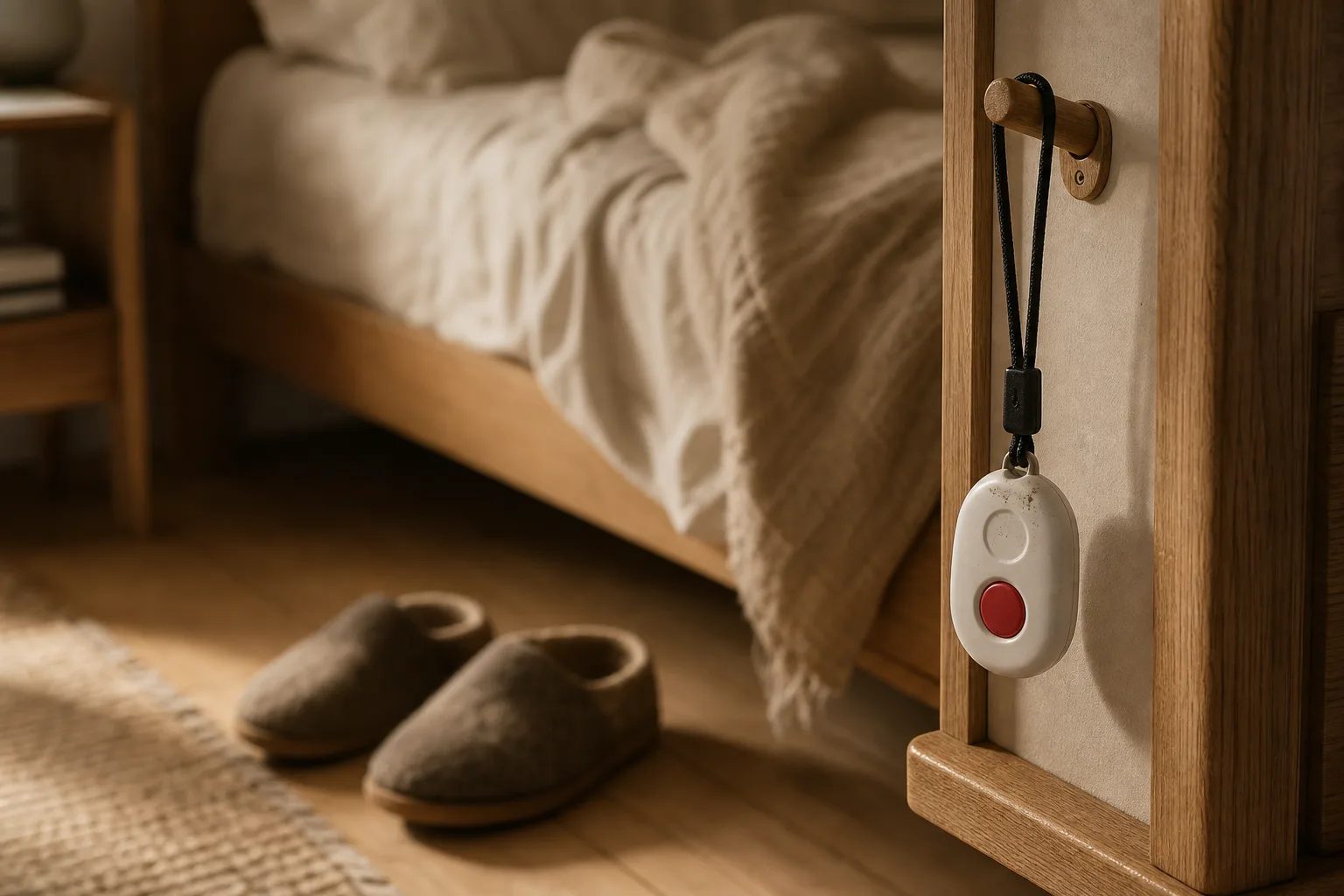
The catch: a button only helps if it's worn and pressed
Back to the 97%. In that study of real falls, the wearers were not confused about how the button worked. They did not want an ambulance, did not want to worry anyone, or planned to rest a moment and get up — and could not. Mary Tinetti's work in the New England Journal of Medicine found that most people who fall cannot get up without help, and that lying unhelped for more than an hour sharply worsens what happens next.
These are not rare-event odds. The CDC counts one fall every year for every fourth adult over 65. So what you are really buying is a chain: worn, in range, charged — and pressed, by a person on the floor deciding whether to be a bother.
A daughter we spoke with bought her father a pendant after a fall. He wore it every time she visited. Then she started noticing it in the background of his video calls — hanging on the bedside hook, behind him.
Two things move the odds. First, rehearse the press: a real button push from the bathroom floor, with the operator answering, so the pendant stops being a taboo object and becomes a fire drill. Second, if your parent refuses to wear anything at all, stop relitigating the pendant and change the plan — our guide for when a parent refuses a medical alert has the scripts and the alternatives.
If the button is the weak link: nothing to wear, nothing to press
This is the category we build in, so read these paragraphs knowing that. OdeCare puts small radar sensors on the walls of the rooms that matter — bathroom, bedroom, hallway. Radar reads presence and movement, with no lens and no microphone, so no image of anyone exists at any point. Nothing is worn, nothing is pressed, nothing needs charging. When the home's pattern breaks — someone got up, reached the bathroom, and the movement stopped — the alert goes to the family contacts you chose.
What we don't do. We don't leave the house: the garden, the shops and the bus are a GPS pendant's job, not ours. We don't offer a button to summon help on demand — there is nothing to press; the system watches patterns instead. And we will never show you a video feed, because radar data has no faces in it.
So the honest sorting rule: for a parent who wears the pendant, keep the pendant. For the one whose pendant lives on the hook, sensors on the wall beat a button in a drawer.
Frequently asked questions
What is the difference between a personal alarm and a medical alert system?
None in the hardware — the name changes at the Atlantic. UK sites say personal alarm, careline or telecare; US sites say medical alert system or PERS. Useful side effect: searching both terms doubles the reviews you find for the same device. One trap: Careline is also a company name in the UK, so "careline reviews" mixes one brand with the whole category.
How can I get a free personal alarm for an elderly person?
In the UK, the council's free care needs assessment is the front door, and hospital discharge is the fast lane — telecare arranged as part of a discharge package skips the waiting list. In the US, look at the Medicare Advantage plan's supplemental benefits first, then Medicaid waivers, the VA, and the local Area Agency on Aging. Rule of thumb: "free" covers the box. Ask what the monitoring costs in month four.
Do personal alarms work without a landline?
Most current units run on cellular or Wi-Fi and never touch a phone socket. The trap runs the other way: UK landlines are being switched to digital voice, and older analogue diallers stop working after the switchover. If the alarm in the house is more than a few years old, ask the provider whether it is digital-ready — before the engineer visit, not after.
Does a personal alarm call 999 or 911 directly?
No — with a monitored alarm, the operator dials emergency services from the centre, with the address and access notes already on screen. That is the argument for a key safe: the operator gives the crew the code and nobody breaks a door. Autodial units should ring people only. A recorded message played at an emergency call handler helps no one.