What Is Telecare? Equipment, Council Routes and Response
Telecare explained for UK families: what careline alarms and sensors do, who answers, how council assessments work, what costs to check and how digital.
Telecare is equipment plus a response service. A pendant or home sensor starts the chain; a person or team still has to receive the event, check what happened and act.
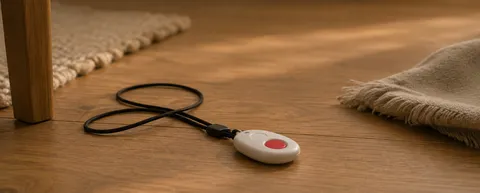
A red pendant is not the whole telecare service. At 2 a.m., the button sends a signal. Someone receives it, tries to speak to the resident, checks the contact plan and decides who should act. Telecare is that chain from event to response.
In the UK, the term can cover a simple community alarm, a door or bed sensor, an environmental alarm, or a larger monitoring arrangement. Ask what is included rather than assuming every “telecare package” works the same way.
Telecare is a chain, not a red button
Read any proposal through five steps:
- Trigger: a person presses a button or a supported sensor event occurs.
- Connection: the signal travels through a landline, digital phone service, mobile network or internet connection.
- Recipient: a monitoring centre, care team or personal contact receives it.
- Verification: the recipient tries to understand what happened.
- Response: a keyholder, responder, carer or emergency service is contacted according to the plan.
A weakness at any step changes the outcome. A perfect button cannot help when nobody owns the call. A staffed centre cannot enter a locked home without an agreed access route.
What equipment counts as telecare
| Equipment | Signal | Dependency to test |
|---|---|---|
| Pendant or wrist alarm | Manual help request; some models add fall detection | Worn, powered, within coverage and pressed when needed |
| Fixed button or pull cord | Manual help request from one location | Reachable from where an event occurs |
| Door, movement or bed sensor | Configured state or routine event | Rule, delay, placement and correct interpretation |
| Smoke, gas, heat or flood detector | Environmental threshold | Correct certification, placement and response route |
| Mobile alarm | SOS and, on some models, location or fall detection | Charging, network, supported area and carrying routine |
The NHS telecare guide lists personal alarms, monitored and family-routed systems, and sensors for movement, doors, temperature, flooding, smoke and gas. The list does not tell you which device this person needs. Start with the event and responder.
Who answers and what happens next
A careline may route a call to an alarm receiving centre. Another service may notify family or care staff directly. Ask the provider to describe the exact no-response sequence:
- Which hours are covered?
- How does two-way speech work from the bathroom or floor?
- Who is called first, and how many attempts are made?
- Is a mobile responder included, or only phone escalation?
- Who can enter, and how is key information kept current?
- When may emergency services be contacted?
Request answer-time and service-quality evidence for the actual monitoring provider. Do not treat “connected to a centre” as a complete response specification.
The council route
Contact adult social services at the council where the person lives and ask for a care-needs assessment. The NHS says the assessment is free and can consider how the person manages daily tasks.
If the council provides telecare, ask what assessment, financial rules and charges apply. The GOV.UK telecare guidance says some local authorities provide services and arrange a home assessment. It does not promise that every council supplies the same device or price.
A private provider can be considered without waiting for council eligibility. Compare the same response questions either way. Public procurement does not automatically make a device acceptable to the person, and private speed does not prove service quality.
Cost, contract and digital switchover
Ask for one written total covering:
- equipment purchase, rental and installation;
- monitoring and connectivity;
- fall detection or extra sensors;
- maintenance, replacement and test calls;
- renewal, cancellation and equipment return.
Also ask how the alarm connects. GOV.UK says the digital phone switchover is expected by January 2027 and that some analogue telecare devices may need upgrading. Contact the landline provider, tell it that telecare is in the home, and ask the telecare provider to confirm compatibility and testing.
Digital voice services can depend on mains-powered home equipment. Ask what works during a power cut, how long any backup is designed to last and how a failed connection becomes visible.
The button limit
A manual alarm helps only when it is within reach and somebody can press it. Automatic fall detection adds another route, but providers warn that it can miss events. That is not an argument against telecare. It is a reason to test the dependency honestly.
Use the real routine:
- Is the pendant worn in bed and bathroom?
- Can the person operate it from the floor?
- Does a fixed cord remain reachable after a fall?
- Who notices a flat battery or lost connection?
- What other layer covers a known gap?
For a person who accepts a button and wants a staffed centre, a traditional careline can be the right fit. For someone who repeatedly removes the device, the problem is the format, not the colour of the pendant.
Where OdeCare fits
OdeCare sits in the installed-sensor part of telecare. Camera-free radar, motion, door and climate sensors connect through a home hub, so supported events do not depend on a worn button or somebody watching video. The mobile app can show alerts, sleep, night getting-up, activity and changes against the person’s usual pattern.
Where partner monitoring is included, an operator can call the resident, call the caregiver and contact local emergency services under the agreed plan. The system is home-only, needs mains power and internet, and covers only the supported rooms and events in the proposal. Confirm current UK availability, monitoring hours, installation, contact channels, price and terms.
A household can still use a mobile personal alarm away from home. The useful question is not “telecare or OdeCare?” It is which combination closes the named gaps without creating an unmanageable routine.