Medical Guardian Alternatives: Choose by the Problem
Medical Guardian fall detection and its alternatives, matched to the problem you're actually solving: a pendant nobody wears, mobile coverage, who answers.
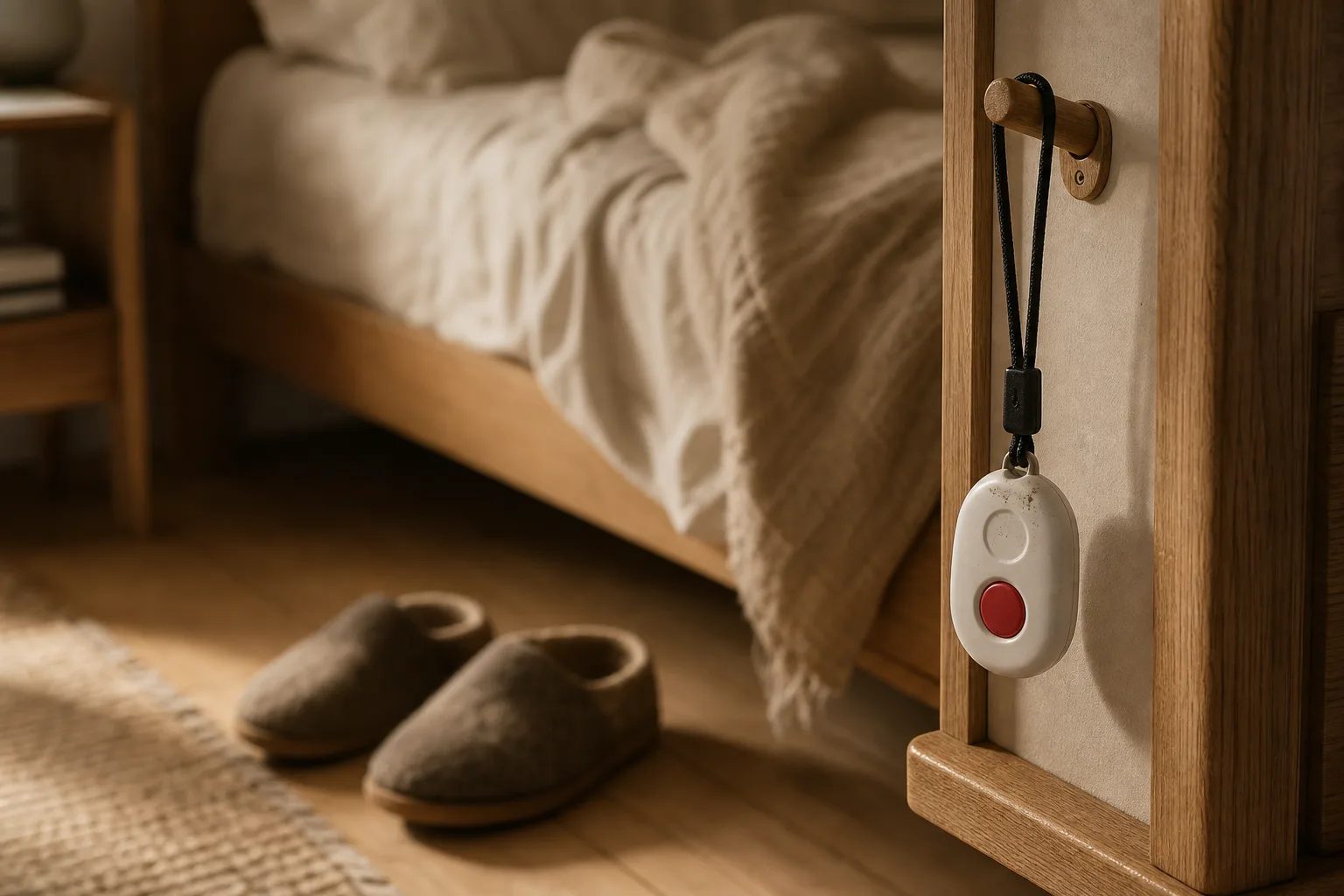
Most people searching for Medical Guardian alternatives believe the device failed. It almost never did. The pendant worked perfectly — from the bedside hook where it hung during the fall in the shower. Swap brands without naming what broke and you buy the same failure in a new box. Below: the four real problems — wearing, coverage, response, cost — and their fixes.
The short verdict
Medical Guardian earns its US shortlist spot when two things are true: the person will actually wear the device, and you want a staffed monitoring center answering it. The range covers in-home bases, cellular mobiles and the MGMove smartwatch — which now lists fall detection as an add-on, retiring the old claim that the watch lacks it.
The catch is condition one. The CDC counts one in four adults 65+ falling each year, and in one study of real falls, 97% of worn emergency buttons went unpressed. The device on the body is the entire system; on the hook, it guards nobody.
A daughter we spoke with kept seeing her father's pendant in the same spot behind him on video calls — it snagged his cardigan, he said, so he stopped wearing it. She was paying for monitoring. Nobody was being monitored.
What Medical Guardian actually sells
Three formats, three routines — and the routine, not the brochure, decides whether the system exists on the day of the fall:
| Route | Built for | The daily routine |
|---|---|---|
| In-home system | Mostly at home, accepts a neck pendant | Pendant on the neck; base in a wall socket with battery backup; range ends at the yard |
| Mobile device | Still drives, shops and walks | Pocket or clip; charges like a phone; cellular and GPS find the wearer |
| MGMove smartwatch | Already wears a watch daily | Nightly charging, cellular signal, fall detection as a paid add-on |
Medical Guardian's current MGMove page lists fall detection as an add-on and daily charging as a fact of life. The MGMini Lite support page describes a different wearing and charging routine entirely. Same logo, different physics: the company's own guidance says placement changes what gets caught. A feature never automatically travels between devices.
The test that matters
A sales call proves features exist. Only a lived-in week proves the device stays on. Run the exact unit for seven normal days and note four moments:
- Getting dressed: does the pendant go on without a reminder — or an argument?
- The shower: it comes off for bathing, and falls love wet tile. What covers that half hour?
- Leaving the house: is the mobile unit charged and in the coat pocket, or on the kitchen counter?
- A test alert: press the button, time the answer, have the operator walk your contact list.
Don't stage a fall — use the manufacturer's test mode. Ask what happens when the wearer can't speak, and how paramedics get through a locked door. Mary Tinetti's New England Journal of Medicine research found most fallers can't get up without help — and lying unhelped past an hour sharply worsens what comes after. A key lockbox on the porch is as load-bearing as the button on the neck.
Medical Guardian alternatives, by problem
If the bill or the agreement is the problem
Shop the terms, not the features. ADT Health, Lively, Bay Alarm Medical and Lifeline sell the same core service — a button, a cellular link, a human on shift — with different bills attached. Our ADT, Lively and Bay Alarm comparison shows which devices carry fall detection at each.
If the pendant is the problem but a watch isn't
Plenty of people refuse a pendant because it announces frailty; a watch announces nothing. MGMove belongs here now that fall detection is on its spec sheet. So does Apple Watch — hard-fall detection, calls emergency services on its own, but expects an iPhone in the family and a charging habit that never slips. Judge them all the same way: automatic detection, manual SOS, who answers, what charges, what stays worn past week three.
If the family wants to answer alerts themselves
A family-dial alarm calls your phones instead of a monitoring center. The device is cheap; the labor lands on you. An operator on shift never sleeps through an alert; a son in another time zone does. Build what a call center would have given you: first responder, backup, acknowledgement rule, key holder nearby. Our guide to medical alert systems with no monthly fee walks through that setup.
If nothing stays on the body
This is the failure families discover last, after the second unworn device. The fix isn't a better wearable — it's taking the body out of the system. Installed sensors watch rooms, not wrists: nothing to put on, charge or remember. The trade is territory: the wall sensor knows the bathroom floor and nothing about the parking lot.
Compare cost without fooling yourself
Monitored pendants run $25-45 a month as of mid-2026, fall detection roughly $10 more — the fee buys humans awake at all hours, not hardware. Price the first year, not the first month:
- monitoring service plus the fall-detection add-on;
- the device, activation and shipping;
- "protection plans", replacement and second-user fees;
- the refund if you cancel a prepaid year in month four.
Those are ballparks — the agreement in front of you is the number that counts. Three services renting the same word: alert.
Make the decision
Pick Medical Guardian — or ADT, or Bay Alarm — when the trial week showed the device staying on and you want professionals on the line. Pick family-dial when your household can genuinely staff it. When the pendant was back on its hook by day three, stop shopping for wearables — that problem has no wearable solution.
It's the problem we built OdeCare for. Radar sensors on the wall — no camera in the system — catch a fall or an unusual stretch of stillness and alert your family through the app. What we don't do: cover anyone outside the house, put anything on the body, or record video — there's no lens to point. If your father spends afternoons out in town, a mobile pendant is still the right tool. Ours is for the home he comes back to.
The question that ends this research isn't "which brand wins?" It's "which routine will this household still be keeping in March?"